It's Friday afternoon and I am listening to some musicians playing Jimi Hendrix on the beach. They are setting up for this weekend's annual Polynesian festival. There seems to be something going on right across the street every weekend.
I was lucky with traffic and able to get home before 5pm. I try to leave work around 4pm on Friday's as my reward for a week of work where I get in for 8am. This week was tough in that I am hitting my first wall. I don't know about everyone else, but I always seem to hit a period where I have taken in so much information that my head gets cloudy and my productivity drops. Normally this happens in week 6 or 7 (this is week 7 for me). I have grown to accept that this is the way I work, try not to be ridiculously unproductive, and let my head settle.
Work is going well. Chris (my team mate and fellow Merage grad) and I arranged to meet with the CFO next week to discuss our proposal to improve our innovation process. Our discussion paper is complete and sent to the CFO so he would know what we are talking about. The paper looks pretty good. We could have gone into more details with the specific numbers, but at this point we would be making pretty big assumptions and the numbers are only a small part of what we want to improve.
Improving the innovation process in a multi-national, muli-business line company is an incredible challenge. In business school we talk about how to fuel new ideas, good environments for creativity, how to commercialize ideas, but I don't think any school talks about how these wonderful theories can work in any incredibly complex organization. In a one business unit company, its easy to align priorities. In a multi-business line company you have competeting interests, infrastructure issues, political issues, and financial resources you need to structure properly before you can even think about creating that environment. So I am a bit lost for the moment as I try to understand this environment in 3 months which realistically should take me 5 years. This may have contributed to the head fog...
Friday, August 22, 2008

Saturday, August 09, 2008
Working For a Living is Different
After 21 months of working on numerous projects, analyzing processes, making recommendations for a variety of topics and companies, it feels somewhat unusual to continuously focus all my efforts on a single company. The great thing about this is that I will have the chance to make a real impact on my company by gradually building influence for some of my ideas.
To date, my job has been incredibly enjoyable. No large company is perfect, but there are a number of things to admire about Experian. It is efficient, has a nice collection of strategic data assets that few can match, and quality people. They have allowed me to slowly settle in by giving me only one project to focus on. This has allowed me to spend some time getting to better know the business and the company.
I am working on my project with another Merage colleague. We were tasked with recommending and implementing better idea evaluation tools into Experian's innovation process (oddly enough a similar project to the one I did in my experiential learning class). Through discussions with executives we have taken it upon ourselves to also recommend changes to the innovation process. So far, we have received a lot of support for our direction, but I can see a number of barriers that we will have to delicately tip toe if we want to improve this critical process.
It's turning out to be a real exciting project. I am not sure if many MBA's straight out of school get the opportunity to lead a project with such impact across a billion dollar multiple business line company. That makes the challenge fun.
Other than that just enjoying our appartment. On certain days the commute can suck (50+ minutes), but I get home on that patio and look at the ocean, a sense of relaxation comes over me (oh yeah, and its nice to see my wife too).
To date, my job has been incredibly enjoyable. No large company is perfect, but there are a number of things to admire about Experian. It is efficient, has a nice collection of strategic data assets that few can match, and quality people. They have allowed me to slowly settle in by giving me only one project to focus on. This has allowed me to spend some time getting to better know the business and the company.
I am working on my project with another Merage colleague. We were tasked with recommending and implementing better idea evaluation tools into Experian's innovation process (oddly enough a similar project to the one I did in my experiential learning class). Through discussions with executives we have taken it upon ourselves to also recommend changes to the innovation process. So far, we have received a lot of support for our direction, but I can see a number of barriers that we will have to delicately tip toe if we want to improve this critical process.
It's turning out to be a real exciting project. I am not sure if many MBA's straight out of school get the opportunity to lead a project with such impact across a billion dollar multiple business line company. That makes the challenge fun.
Other than that just enjoying our appartment. On certain days the commute can suck (50+ minutes), but I get home on that patio and look at the ocean, a sense of relaxation comes over me (oh yeah, and its nice to see my wife too).
Sunday, July 13, 2008
Some Additional Questions
I recently had a discussion about Merage on my professional blog. I wanted to reproduce the discussion here because I answer a number of questions about Merage that you might be interested in.
5 Comments
Friday, July 11, 2008
Our California Dream Apartment
Here's our building


I just sat on the patio. Isn't is awesome.

We're up on the upper level - See there's Lindsey!
Here is the inside. Lindsey got the Landlords to put in new flooring before we moved in. Lindsey did a good job of decoraing.


I just sat on the patio. Isn't is awesome.

And here is the view. This sealed the deal on us picking this place.

It makes for a pretty good party place too!


It makes for a pretty good party place too!

Friday, July 04, 2008
Quick Props to My Polaris Investment Competition Team
I want to say thanks to my Polaris teammates and Chuck Martin, the sponsor of the competition. For those who don't know, Polaris is one of Merage's unique competitions where teams of students are responsible to invest $250K of Chuck's money in the stock market over the course of a year.
This year was a tough year for investors (the S&P return was negative). 5 teams competed and 4 delivered positive returns (the top 2 teams were over 30%!); killing the market and probably beating most professional investors. Our team came 4th with a return in the area of 11% (earning each member a scholarship of $1800). We started the competition like we were shot out of a cannon leading the competition for almost half a year, but the market caught up with us. Timing definitely had a big impact on our portfolio, but we took away great lessons about team work, decision-making, taking market gains, attention to detail, and trusting our analysis. For a team with no investment experience, I am very proud of our efforts.
Credit must go to my teammates Girish Simon, Priyanka Saxena, and Craig Young. Special thanks goes to our team leader Petra Neumayr who kept us on track. Below, my team - The Intangibles:

This year was a tough year for investors (the S&P return was negative). 5 teams competed and 4 delivered positive returns (the top 2 teams were over 30%!); killing the market and probably beating most professional investors. Our team came 4th with a return in the area of 11% (earning each member a scholarship of $1800). We started the competition like we were shot out of a cannon leading the competition for almost half a year, but the market caught up with us. Timing definitely had a big impact on our portfolio, but we took away great lessons about team work, decision-making, taking market gains, attention to detail, and trusting our analysis. For a team with no investment experience, I am very proud of our efforts.
Credit must go to my teammates Girish Simon, Priyanka Saxena, and Craig Young. Special thanks goes to our team leader Petra Neumayr who kept us on track. Below, my team - The Intangibles:

Thursday, June 19, 2008
My Final MBA Thoughts
Here are a few of my parting MBA thoughts for anyone thinking about taking an MBA.
- The Merage School is a top notch MBA program for Marketing, Finance, Strategy, Real Estate, and Information Technology Management, but I think the big differentiator is how it exposes students to concepts of Strategic Innovation. Strategic Innovation adds an entire new dimension to an MBA education that will grow in demand as companies mature.
- Work a few years before pursuing an MBA. I see a trend of many students jumping from undergrad to the MBA. I may be biased here, but a great deal of the MBA learning experience is translating the lessons into previous work experiences. I believe this enriches your learning experience and adds value to your investment.
- If you have a specific company you want to work for after your MBA make sure they regularly visit your selected school. I am not saying it is impossible to work for them if they do not, but it will present you with many more opportunities.
- Your MBA program is a 21 month job interview. Everything you do in this program will be remembered by your classmates who will be one of your most valuable assets in your career. So to make the most of this experience, you must always represent yourself with integrity, motivation, and respect. If you are not ready, then do yourself a favor and wait until you are ready.
- Be prepared to work more than you are used to. Days, nights, weekends are more than cell phone plan terms. This will not be like your undergrad.
- Prioritize. At times you will be overwhelmed with the work. Your key will be identifying what work will give you the greatest return.
- You will learn much more than your brain can absorb. I still have a wealth of lessons floating around in my brain, waiting to processed and categorized. I hope to be able to do this before I start working, but I doubt it.
- Extra-curricular activities are just as important as the academics. I think this hard for some internationals to understand, but in a U.S. program these extra-curricular activities are incredibly important because 1) they are great opportunities to network and bond with other students; and 2) recruiters look at these to see that you exposed yourself to experiences beyond the classroom and use them as great interview questions.
- Get to know your classmates. This should go without saying to an MBA applicant, but there will be students who you will rarely see in your program. In my opinion, this is a waste of an MBA education (you should be seeing a theme here that the true value of an MBA is outside of the academics). You will forget most of your class lessons; you will never forget the classmates who shared the experience and invested themselves in getting to know you.
- Get to know your teachers. This is an area of weakness for myself, but your teachers can be great resources to you in your career. Build a great relationship with them now, in order to make it easier to contact them in the future.
- Orange County is a pretty nice place to go back to school.
End of the Road - Graduation
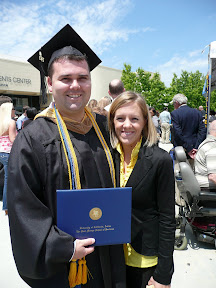 Twenty-one months comes pretty quick. Graduation was held last Sunday at UCI's Bren Events Center. The ceremony was only 2 hours, but had to show up at 7:30am in order to have class pictures. Of course 7:30am is California MBA code for we are taking pictures at 8:30am, but if we don't say 7:30am you would not show up until after convocation started.
The ceremony made everything official - I have now earned my MBA from a top U.S. university. It was a nice opportunity to thank all of my classmates and wish them luck.
 That evening Lindsey, myself and my parents went out to Laguna Beach to celebrate. First we had a drink on the rooftop patio over Hotel La Casa del Camino which has an incredible view of the Pacific Ocean. After the drink, we headed downstairs to the K'Ya Restaurant for a nice dinner. The K'Ya is great because it offers small plate versions of their dishes allowing us to sample and share many different dishes. It was pretty good food and reasonable prices.
Now that the MBA is officially over this blog will transition to more of a family update blog. I will post two more posts on some final thoughts about doing an MBA and a comparison of the MBA to Law School. In the future, I will post about some alumni endeavors as they arise. If you are interested in following my views from a career perspective, I started a professional blog at www.mytechnologycompany.com.
Subscribe to:
Posts (Atom)



Please login to rate.
Do you already have an account? Log in and claim this comment.
I have a few questions about Merage, and was hoping you can give me some honest answers. I've spoken with adcom staff and student ambassadors, but wanted to get another opinion. :)
1) How was the job placement this year? Did most students get jobs of their choice?
2) Do you know what the average starting salary was? I was surprised to discover that the average starting salary for Merage students in 2007 was almost $20K less than schools with the same ranking..
3) What is the job placement like for the Bay Area? I eventually want to move back to the Bay Area, but it seems like most Merage students stay in the OC. So, just a little concerned.
Your input is greatly appreciated! Oh, and major congrats on graduating and scoring a cool job!
Please login to rate.
Do you already have an account? Log in and claim this comment.
Thanks for you kind words.
Some honest answers to your questions.
1) Job placement was tougher this year due to the economy. I think we may be
lower than last year for placement before graduation, but I expect we'll be
equivalent for placement after 3 months. The interesting thing about hiring
this year was that despite the down turn there were a number of very high
profile jobs posted - so companies are still making strategic hires at
Merage.
2) Average starting salaries are a distorted measure used by ranking
systems. It is difficult to talk about average starting salaries without
first talking about the job type. As an example consulting generally pays a
higher salary due to the life demands it puts on its employees (so schools
who produce a higher ratio of consultants will have their average salary
inflated). While I don't necessarily think 20K lower is correct, you are
right to note that salaries from Merage are generally lower than similar
ranked programs. This is because a high percentage of its students remain in
Southern California. Salaries in the OC are often subject to what I call the
"lifestyle tax". Because it is such an attractive area to live, there are
more candidates for jobs, pushing down wages. This "lifestyle tax"
artificially lowers Merage's average starting salary. I hope you get my
drift why I say the average starting salary is a skewed school indicator. I
will say as a person who grew up with humid summers and cold winters the
lifestyle is wonderful and I am willing to accept the "tax".
3) Interestingly, this year we have a number of students going to work up in
the bay area (5-10% of the class). The companies range from start-ups to big
companies like HP. Last year, we had a student get into google. I won't say
trying to find a job in the bay area is easy. You will be mostly on your own
and will need to actively network with people in the area starting now if
you want to go back with a great position. I suggest find conferences that
suit your preferred industry/job function that are hosted in the bay area.
That raises the chances of people from the area attending. Then network and
stay in contact with those people. The conferences worked out real well for
me this year (I had three solid job opportunities arise) and I recommend
start doing it as a first year.
Please login to rate.
Do you already have an account? Log in and claim this comment.
Great tip about starting early with networking! Where can I find these industry conferences? Any tips?
Also, I am seriously considering studying abroad for a quarter (something I always regretted not doing in college). Do many Merage students study abroad? Would studying abroad for a quarter put you behind other students (in terms of job search/accumulating enough credits to graduate)?
Thanks in advance!!
Please login to rate.
Do you already have an account? Log in and claim this comment.
To your follow ups:
1. You can track down conferences by reading blogs in your field of
interest, tracking down professional associations of field of interest, or
often if you have a target company they will highlight which conferences
they go to on their web page (or just do a google search).
2. Many students do a study abroad and it is a fantastic experience. You
will be behind on job search if your primary field of interest is consulting
or working with a large company with an established MBA hire program.
Otherwise job search doesn't ramp up until February onward. I used my Q1
Year 2 to ramp up my networking in order to hit the ground running in Q2.
Good luck.
Please login to rate.
Do you already have an account? Log in and claim this comment.